
Training in Retrospect
First published many years ago - reprinted to english.

Before commercialism took over and it became a sport in itself to outdo one another in death workouts, printed in colorful magazines, there was a certain consensus about what worked and what didn’t. Many things have stood the test of time, some new things have been discovered and others simply rediscovered, while much still lies hidden in forgotten books and protocols. Sports science has never before been as interested in bodybuilding and heavy lifting as it is today.
The irony of this newfound interest is that it doesn’t invent new techniques, but merely confirms what was commonly known decades ago, but was lost in the current supplement era. Some of the principles that have been developed have been useless and others a success; in this post, I will briefly go through a number of them to illustrate just how many different tools you actually have at your disposal, and briefly touch upon some of the things that have seemingly received more praise than they deserve.
The Legends’ Fullbody
Reg Park, Steve Reeves, Bill Starr and Tommy Kono. Legends who were just as strong as they were big. All of them were advocates of fullbody training. Workouts that all resembled one another, with big, heavy compound lifts, a focus on progression and strength development rather than pump and biceps measuring tapes. Their workouts seem very simple, but genius can often be hidden in the obvious. What these fullbody programs had in common was a good amount of strength progression and a relatively high frequency for the muscles, in the region of 2–3 times per week, which is what science later found to be far more optimal than lower frequency, albeit with diminishing marginal returns. Squats, deadlifts, overhead presses and pull-ups could often be all the workout consisted of, and yet they all presented impressive physiques. Some of them were even around before steroids became widely available.
Arthur Jones and HIT
Arthur Jones and later Mike Mentzer were the great iconic advocates of High-Intensity Training (HIT). Both of them, however, became obsessed with making it more and more extreme, by guaranteeing better and better results with less and less effort. They most likely did this in order to distance themselves from the rest of the fitness industry and sell more memberships to ordinary people.
Before Mentzer muddied the waters and Nautilus owner Arthur Jones turned it into a fitness chain concept, HIT was much more in line with old-school training and produced formidable bodybuilders such as Casey Viator. However, there were a few more nuances and ideas hidden behind the provocative HIT of the time. Like Starr and Kono, Jones was a fan of big exercises such as squats, dips and deadlifts, and believed that if you hammered the big, strong muscle groups with solid exercises, it would automatically spread to the somewhat smaller and supporting muscles like ripples in a pond. He did, however, differ significantly by introducing the concept of pre-exhaust and a whole range of other intensity techniques designed to take you to complete concentric failure. Before several of Jones’ trainees even got to the squat, they had performed a set of leg extensions and leg presses to concentric failure, with good technique, mind you!
When pressing, they would often fatigue their triceps by performing overhead extensions before doing dips. Jones was a great advocate of training to failure, but it should always be concentric failure with flawless execution, and there should NEVER be any forced or assisted reps involved. So there was a relatively high frequency of 2–3 times per week, with big, heavy lifts, and by using intensity techniques such as pre-exhaust, Jones could specify which muscles should receive the most focus during training. The Nautilus concept and others later took HIT to the extreme, primarily for commercial reasons, which among other things gave rise to the final section of this post. Oh yeah, it was probably also popularized in modern times by Dorian Yates with his legendary Blood and Guts videos.
Bulgarian and Norwegian Frequency
In the old Soviet Union, there was a consensus that if you wanted to be good at something, you had to practice it. It was an old athletics and gymnastics mindset that was transferred to sports such as weightlifting—and what weightlifters they produced. The Soviet system focused on general athletic training and long-term periodization, something that was shaken to its foundations by Abadjiev, the Bulgarian national coach.
Abadjiev took specificity to previously unknown heights, as his weightlifters almost exclusively performed the competition lifts and trained to daily maximums that resembled their podium lifts. His ultra-high-frequency and highly specific training made Bulgaria the absolute most dominant weightlifting nation in modern history. This way of training destroyed many young talents, but Abadjiev had hordes to choose and pick from. His training methodology was later modified by various nations, but the greater degree of specificity and frequency was here to stay in weightlifting.
In more recent times, the Norwegian national coach Dietmar Wolf introduced many of Abadjiev’s weightlifting principles to powerlifting, with tremendous success. Powerlifting is, to a lesser degree, a technical sport than weightlifting and to a greater degree a competition in absolute strength, hence a problem arose with specificity, as the athletes would otherwise spend all their time squatting enormous amounts of weight and quickly break down. Wolf solved this by introducing a greater degree of variation in the main lifts and lower intensity. So, unlike Abadjiev, the Norwegian lifters perform several different kinds of squats, bench presses and deadlifts.
The Norwegians and Germans are fortunately thorough people, and they have themselves conducted a large study on the development of their training, and it has to be said to be documented as highly effective. If you are interested, just Google “Norwegian high-frequency study.”
Russian Training
The Soviet and now Russian model has always been characterized by a great deal of basic training with incredibly high volume and, as mentioned earlier, it is less specific than the Bulgarian version. It also differs significantly in an entirely different parameter, namely how heavy the weights being lifted are. The Norwegians have learned from this, and Arthur Jones also had an element of it in his training: you always lift with perfectly executed technique.
The Russian and Norwegian methods, however, achieve this by never pushing the lemon 100%, but by staying a couple of reps away from failure. But does that mean you should just walk around taking it easy? No. Initially, you are relatively unconditioned, and your effort will therefore be characterized by the fact that performing new movements is disproportionately hard, despite the fact that you are most likely lifting relatively light weights. Your body, however, is cleverly designed and quickly adapts to new stimuli, and during the initial phase you will quickly discover that everything becomes a little easier. As was shown with diminishing marginal returns, the curve starts steep and then quickly levels off. Because even though it is relatively easy at first, that only lasts for a short while, and you have to push the lemon harder and harder.
So even though you should not perform forced reps or dive-bomb yourself into a death workout that requires you to be rolled out in a wheelchair, you will quickly reach a level where you have to squeeze your cheeks together just to get through all the lifts! The third leg of the periodization model, intensity, must not be forgotten!
Isolation Exercises and High Splits?
Getting a lot out of doing little has always appealed to people, and the increasingly commercial form of HIT quickly became popular with Nautilus. Frequency often dropped to below one workout per week, and in return, the need to split the body into smaller and smaller parts increased in order to satisfy the neurotic need to train. As bodybuilding became more and more commercial, training often became more and more extreme as well. Whether it was a need to make sure you trained more than your competitors or simply because it looked good in the magazines is unknown, but I would argue that it is a plausible assumption, considering the low self-esteem of many in the environment. It has all gone hand in hand with the use of anabolic drugs, and eventually even former champs have started criticizing the younger generations’ monstrous consumption of cocktails and exotic compounds.
But does that mean the grotesque development of 14-splits and HARDCORE pump training has all been a waste? No. As so often happens, people’s enthusiasm and innovative thinking run ahead of science, and as researcher Brad Schoenfeld himself says, science does not invent any new training; it merely confirms parts of what is already known. Several of the intensity techniques and ways of performing agonist, antagonist and pump training are here to stay and may have their justification in different contexts. Modern bodybuilders are, after all, miles ahead in terms of muscular development compared to just 20 years ago, but could they have reached even further by training more frequently? I honestly don’t know, but the prerequisites for growth also change when you throw drugs into the process.
Implications
Most of the topics above have been confirmed over time, and the only thing we can unequivocally confirm from all of it is that, as human beings, we grow bigger and stronger by gradually lifting heavier things up and putting them back down again. But is that really the only thing we can use all of this for?
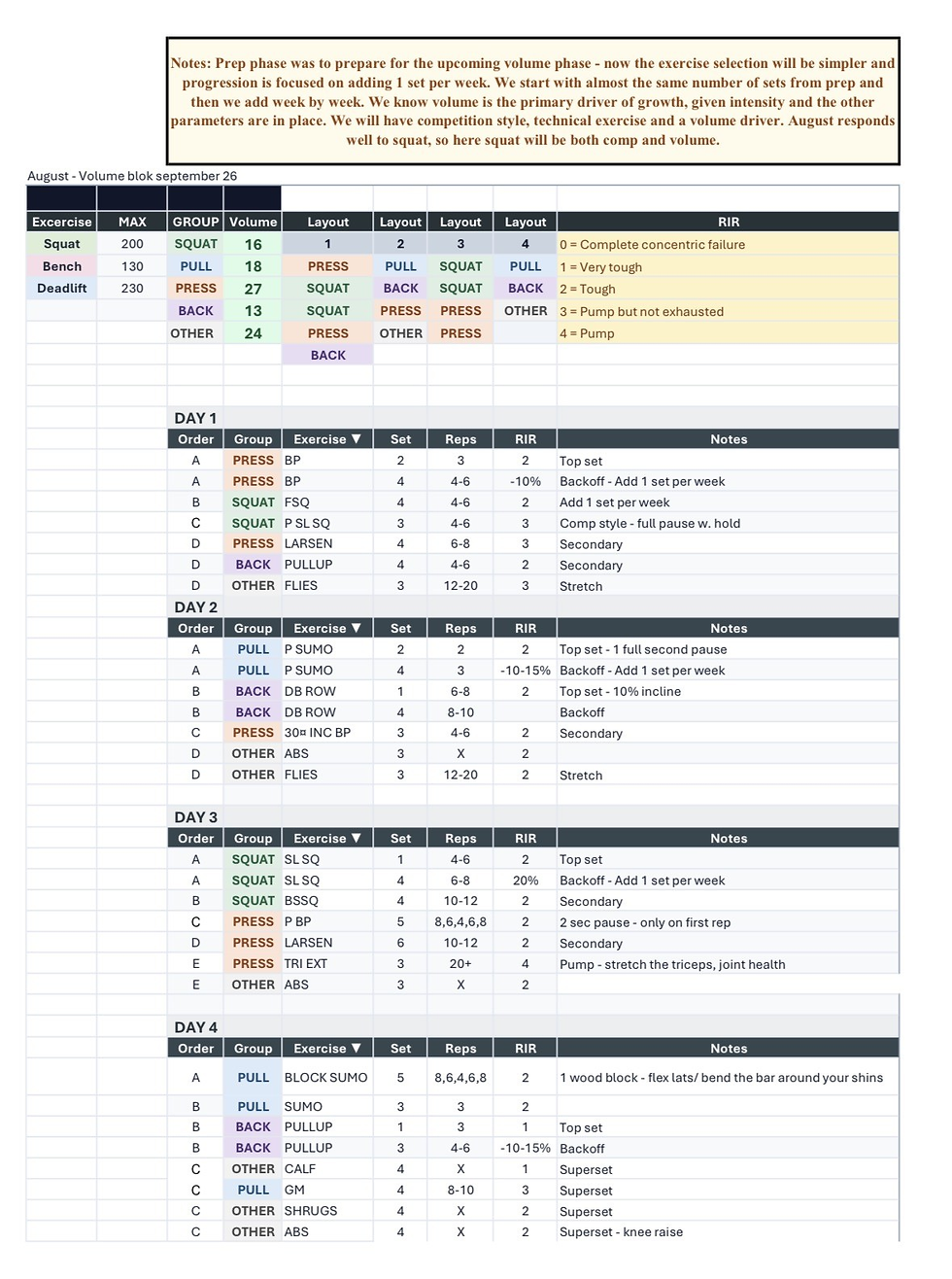
In the article on periodization, block periodization is mentioned, among other things. Periods with different training focuses have proven to be a highly successful way of training, and that is precisely what all the different topics have in common: they are different.
Chinese weightlifters have started doing bodybuilding, powerlifters have started doing high-frequency training, and more bodybuilders have started incorporating progression into their training. I think we have an exciting era ahead of us.
So the next time you sit down and consider the next couple of weeks of training, take a close look and see if there isn’t a new technique you could apply or an entirely different focus you could incorporate into your eternal pursuit of bigger muscles.
Success lies in progression AND partial variation, so shake things up and, as always...
Next time
Next time, I think I will write a little about a planned periodization for a young, strong man who has just had a major weight loss and changed his technique, so we can take a closer look at the implications of the above.

Comments